
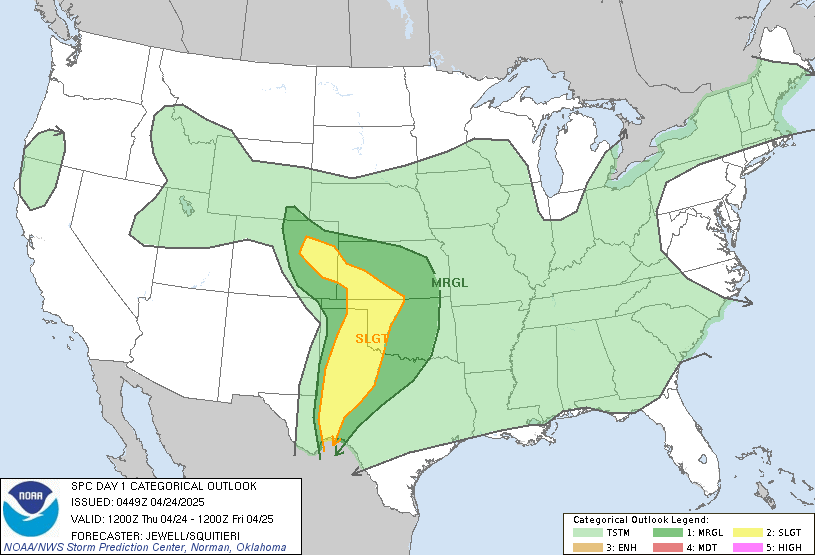
SPC 1200Z Day 1 Outlook
Day 1 Convective Outlook
NWS Storm Prediction Center Norman OK
1139 PM CST Thu Jan 22 2026
Valid 231200Z - 241200Z
...NO SEVERE THUNDERSTORM AREAS FORECAST...
...SUMMARY...
Scattered weak thunderstorm activity is likely today into tonight
across the Texas Big Bend region into central Texas.
...Synopsis...
Late-evening water-vapor imagery depicts increasing ascent across
northern Mexico into the Southwest/Big Bend region of TX as an upper
low off the southern CA coast begins to slowly shift east. At the
surface, a cold front continues to push south across the Plains with
modest moisture return ongoing along the TX Coastal Plain.
Precipitation is expected to slowly increase from the Big Bend
region northeastward into the southern Plains/Ozark Plateau through
the day as isentropic ascent strengthens across central TX. Isolated
to scattered thunderstorm development is anticipated along and north
of the cold front as it impinges on a plume of returning moisture.
...Big Bend Region to Central Texas...
Moisture return of mid 50s to low 60s dewpoints along and south of
the I-10 corridor and into the Big Bend region is expected by
evening and should support a swath of 500-1000 J/kg MLCAPE.
Scattered thunderstorm development is expected along the front
across the Edwards Plateau by early evening, spreading east as the
front pushes further into the unstable air mass. While a few storms
may initially be surface-based, northeastward storm motions will
quickly displace any deep convection onto the cool side of the
boundary. Wind profiles are expected to strengthen through the day
in response to the approaching upper wave, and could support
effective shear values on the order of 40 knots. Despite this, a
combination of modest buoyancy profiles (lifted indices generally -2
to -3 C), rapid undercutting by the front, and a propensity for
storm interactions/upscale growth should largely mitigate the
potential for severe convection.
A few CAM solutions, notably the 00z HRRR, hint at the potential for
upscale growth of a surface-based convective cluster as it
propagates eastward along the front with an attendant threat for
damaging winds. While plausible given the aforementioned CAPE/shear
parameter space, the lack of supporting signal in other CAM
solutions and ensemble/calibrated guidance, along with unfavorable
phasing with the diurnal cycle, suggest that this is a relatively
low probability scenario.
..Moore/Thornton.. 01/23/2026
