
Apple’s original Vision Pro spatial computing headset launched two years ago today.
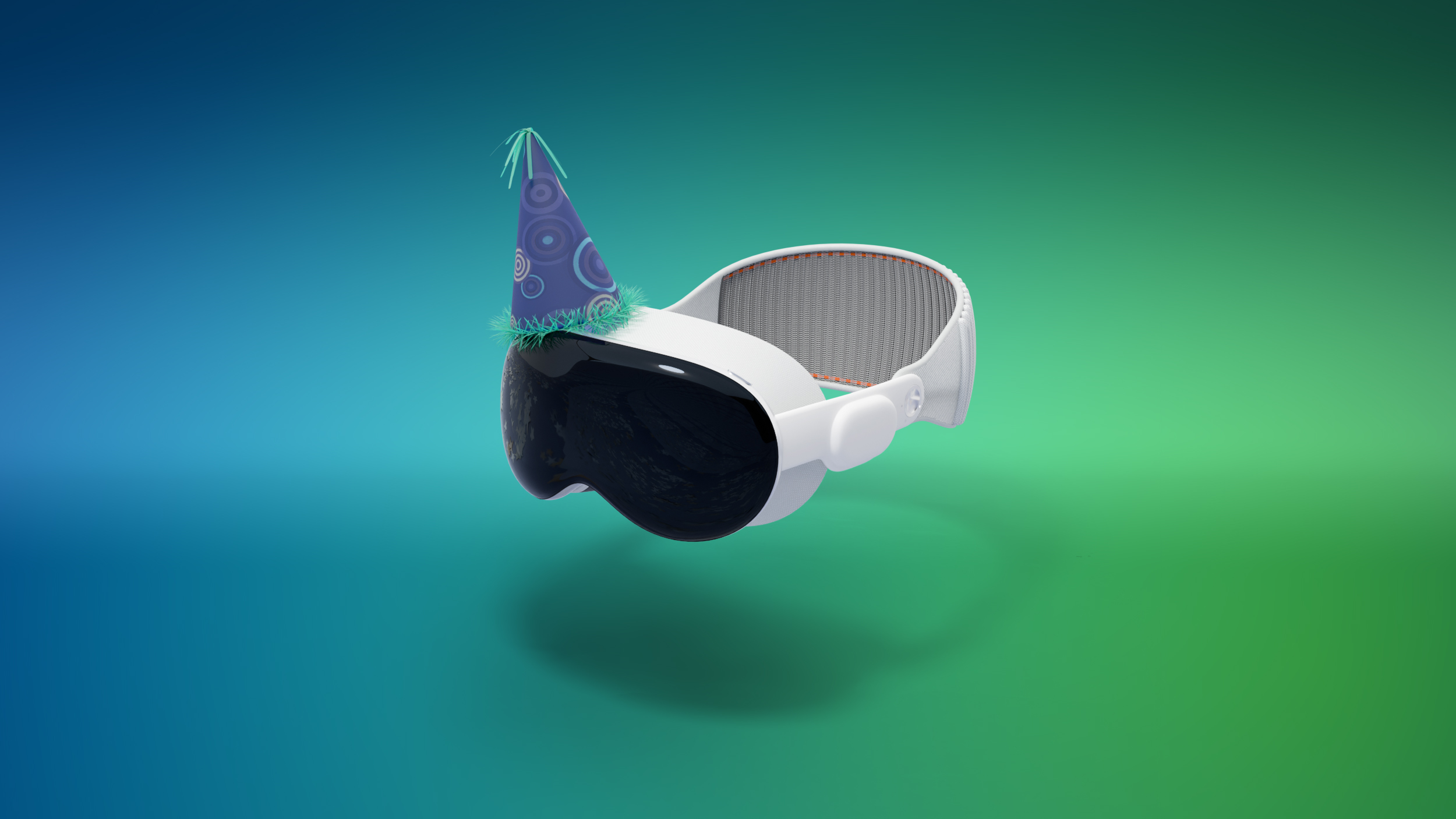
Apple’s work on a head-mounted device was the subject of rumors for many years before the Vision Pro’s announcement. By the early 2020s, those reports had converged around the idea that Apple was preparing a high-end mixed-reality headset positioned as a new form of general-purpose computer.
Apple finally revealed the Apple Vision Pro in June 2023 during its annual Worldwide Developers Conference (WWDC), marking the company’s first major new hardware platform announcement since the Apple Watch. In its initial announcement, Apple described Vision Pro as its first “spatial computer,” introducing visionOS, a new operating system designed around three-dimensional app windows controlled by eye tracking, hand gestures, and voice input. The device combined dual micro-OLED displays with a total of roughly 23 million pixels, advanced sensor arrays, and custom silicon, including the M2 chip and a dedicated R1 chip for real-time sensor processing. Apple also announced a starting price of $3,499 in the United States and said the product would launch in early 2024.
The Vision Pro launched in the United States on February 2, 2024. Initial reviews broadly praised the visual quality, eye- and hand-tracking accuracy, and technical ambition of the product, while also noting its high price, physical weight, limited battery life, and a comparatively small library of software designed specifically for spatial computing. Following the launch, Apple gradually expanded Vision Pro availability to additional countries and continued to update visionOS with new features in 2024 and 2025.
The headset was never expected to be mass-market from day one, according to Apple. Even so, enthusiasm reportedly cooled far faster than anticipated. The latest report on the matter was published earlier this month by the Financial Times, claiming that the Vision Pro is still failing to catch on.
Roughly a year and a half after the initial release, Apple introduced an updated Vision Pro model featuring the M5 chip, representing the first hardware revision of the device. The M5 chip enabled 10% more rendered pixels, a refresh rate of up to 120Hz, better responsiveness, and up to an extra hour of battery life. Apple also introduced a counterweighted Dual Knit Band designed to improve comfort.
Reports suggest that there are now no Apple Vision headsets in active development, with the company’s focus pivoting decisively to smart glasses. Soon after launch, Apple was believed to have shifted focus to a lower-cost “Vision Air,” designed to bring spatial computing to a wider audience through a lighter and cheaper headset, while also planning a redesigned Vision Pro 2 for later in the decade.
By mid-2024, that plan appeared to change and the company’s once-ambitious multi-year roadmap for the Vision Pro is said to have unraveled. A report from The Information said Apple had suspended development of the redesigned Vision Pro, redirecting resources toward the cheaper model, which itself later slipped amid cost and design challenges.
Supply-chain reports suggested Apple was winding down production of the first-generation Vision Pro due to weak demand and excess inventory, with the company pivoting to a chip refresh to use up stockpiled components. A year later, Bloomberg reported that Apple also paused work on the lower-cost headset, shifting its focus toward smart glasses, potentially leaving no next-generation headset hardware in active development.
This article, “Apple Vision Pro Launched Two Years Ago Today” first appeared on MacRumors.com
Discuss this article in our forums
