
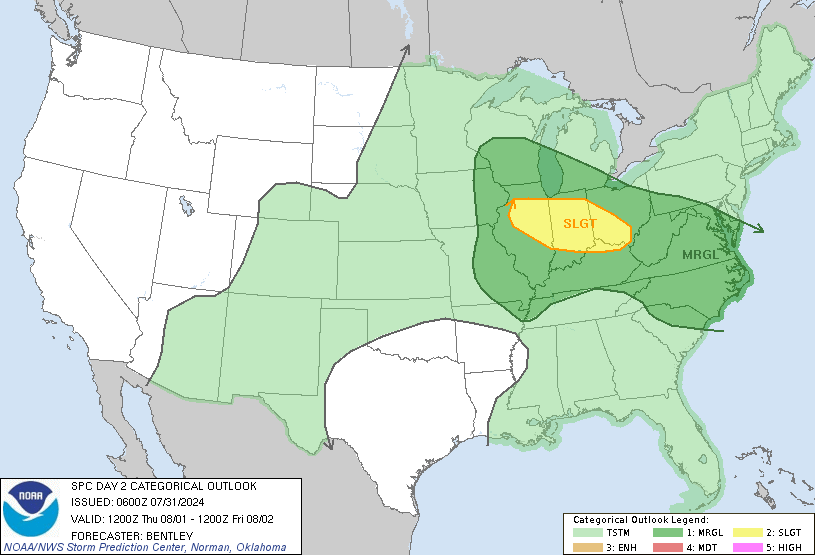
SPC 1730Z Day 2 Outlook
Day 2 Convective Outlook CORR 1
NWS Storm Prediction Center Norman OK
1154 AM CST Sat Dec 27 2025
Valid 281200Z - 291200Z
...THERE IS A MARGINAL RISK OF SEVERE THUNDERSTORMS SUNDAY AFTERNOON
AND EVENING ACROSS PARTS OF EAST CENTRAL AND SOUTHEAST
MISSOURI...ADJACENT NORTHEASTERN ARKANSAS AND NORTHWESTERN
TENNESSEE...CENTRAL AND SOUTHERN ILLINOIS...INDIANA...WESTERN OHIO
AND ADJACENT SOUTHERN LOWER MICHIGAN...WESTERN AND NORTHERN
KENTUCKY...
CORRECTED FOR TYPOS
...SUMMARY...
Strong thunderstorms may develop across parts of the middle
Mississippi Valley Sunday afternoon, accompanied by at least some
risk for severe weather while spreading into the lower Ohio Valley
through Sunday evening.  This may include potential for a tornado or
two across parts of central Illinois into north central Indiana.
Otherwise, potentially damaging wind gusts appear the primary severe
threat.
...Discussion...
Much of the interior U.S. remains anomalously warm, as westerlies
across the Pacific into western North America undergo amplification.
Later today through Sunday, models indicate that this will include
mid/upper ridging building inland across British Columbia and the
Pacific Northwest, through the Canadian/northern U.S. Rockies and
adjacent Prairies/northern Great Plains.  Downstream, it appears
that a pair of short wave troughs will come in phase while migrating
across and east of the Rockies, and provide support for strong
cyclogenesis.  By late Sunday night, guidance generally indicates
that the center of a deep, occluding surface low will reach the Lake
Huron/Georgian Bay vicinity, with a strong trailing cold front
advancing through the western slopes of the Appalachians and
northwestern Gulf/Gulf coast region.
...Middle Mississippi/Ohio Valley...
There remains notable spread within/among the various model output
concerning the evolution of the developing surface cyclone across
the lower Missouri Valley through Great Lakes region, including
timing of periods of more rapid deepening Sunday through Sunday
night.  This could substantially impact the location, timing and
extent of any associated thunderstorm development and accompanying
severe weather potential.
In general, it does appear that the pre-frontal warm sector will be
relatively moist, with surface dew points near/above 60F likely as
far north as a developing warm front, east of the deepening surface
low, across parts of middle Mississippi Valley into southern Great
Lakes region by Sunday afternoon.  Convection allowing guidance and
other model output suggest that forcing for ascent along the warm
front, near and east of the low, may be the focus for highest
thunderstorm probabilities through the period.  However, based on
forecast soundings, relatively warm mid-level temperatures will tend
to minimize CAPE, and the risk for severe hail and wind with
convection rooted above the cool/stable boundary layer appears
negligible.
Relatively warm air aloft appears likely to be problematic within
the surface warm sector as well, particularly given forecast weaker
mid/upper forcing for ascent.  However, there does appear a
consensus in model output that a corridor of weak pre-cold frontal
boundary-layer destabilization could develop by early Sunday
afternoon across parts of south central/east central Missouri into
central Illinois.  Coincident with strengthening deep-layer wind
fields/shear and perhaps a period of glancing mid/upper support for
upward vertical motion, there may be a window of opportunity for
strong thunderstorm development, which could spread just ahead of
the front into the Ohio Valley before diminishing Sunday evening.
Based on forecast soundings, low-level hodographs to the
east-southeast of the deepening cyclone may become conducive to
low-topped supercells posing the risk for a tornado or two across
parts of central Illinois into north central Indiana late Sunday
afternoon.  Otherwise, low-level hodographs, trending more linear
along the cold front to the southwest, will generally support a
narrow line of convection with potential mix down 40-50 kt mean flow
in the lowest 3 to 6 km.
Once thunderstorm development wanes, the potential for convectively
enhanced gusts will diminish, but strong wind gusts associated with
the cold frontal passage are likely through much of the remainder of
the Ohio and Mississippi Valleys.
..Kerr.. 12/27/2025
